A seat map can make a $30 aisle seat look like an easy decision. It’s less compelling if the same flight has a free aisle seat six rows back—or if the $30 buys a seat on only one leg of a connecting trip.
Choose the seat by working backward from what you need: room for your knees, a quick exit for a tight connection, a place next to your companion, or simply a window. Then check what the fare already includes. A seat labeled “preferred” may be better located without offering an inch more legroom.
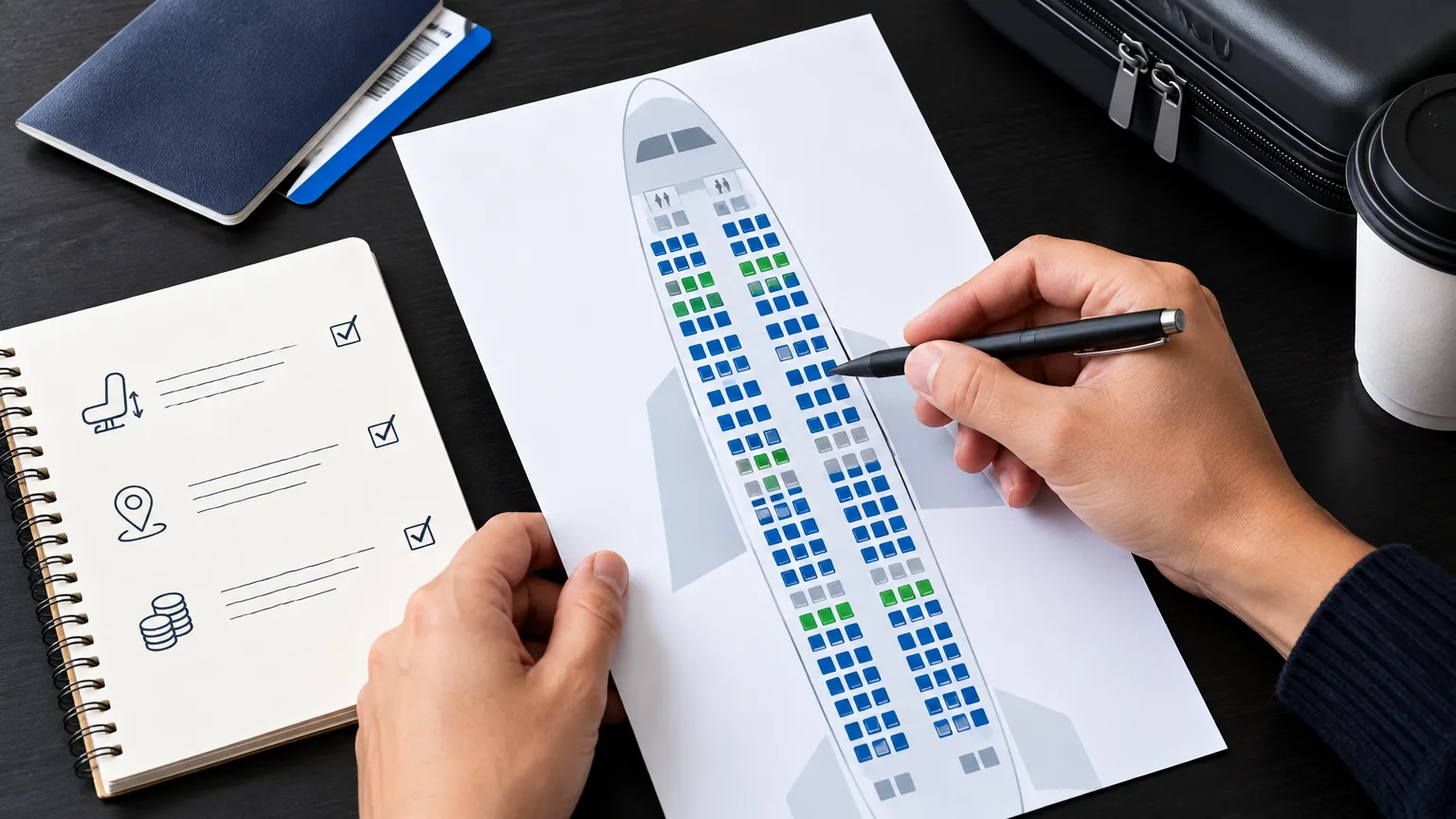
Check the fare before choosing a row
The cheapest fare and the cheapest trip aren’t always the same thing. Seat selection may be included with one fare, cost extra with another, or be unavailable until check-in. Compare the total for the seats you want—not just the headline airfare.
On American, a Main Cabin fare includes free selection of available standard seats; Preferred and Main Cabin Extra seats are separate choices. Its Basic Economy fare lets travelers choose a specific seat for a fee, or receive an automatic assignment at check-in at no charge. Delta Main Basic generally assigns seats after check-in, though advance selection may be offered for a fee in some cases. Those policies show why it’s worth reading the rules for the exact fare on your screen rather than assuming “economy” means the same thing across airlines.
Southwest is also a poor candidate for old seat-selection advice: it introduced assigned seating for travel beginning January 27, 2026. Its Standard seats have standard legroom, Preferred seats have standard legroom nearer the front, and Extra Legroom seats offer more space. Basic-fare seats are assigned at check-in unless another seating benefit applies.
Before paying, ask two questions: Can you pick an acceptable standard seat for free? And would a higher fare that includes seat selection cost less than the lower fare plus the seats you plan to buy? Include every passenger and every flight segment in that comparison.
Read the seat map in two passes
First, confirm the aircraft and the operating airline shown on your booking. A flight sold by one airline may be operated by a partner, and the partner’s cabin and seat rules are the ones you’ll experience. If the map is sparse or unclear, look up the operating airline’s aircraft layout. Delta’s aircraft pages provide seat maps and specifications, while American’s plane listings show seat pitch and width by cabin and aircraft version. Match the version where one is given; a model name alone may not settle the layout.
Then inspect the individual seat. Colors often indicate a fare category, not a comfort rating. Open the seat details or legend and look for:
- A window, aisle, or middle position—especially where a narrow row, galley, or staggered cabin makes the drawing less obvious.
- Exit rows, bulkheads, lavatories, galleys, and the wing.
- Notes such as limited recline, an obstructed window, or a fixed armrest.
- The difference between an available seat, an occupied seat, and one the airline has blocked from selection.
Don’t treat a blocked seat as a vacancy you can count on later. Nor should you pay for a forward seat without checking the row immediately behind it: the seat you actually prefer may be free.
Seat maps are also snapshots, not promises about the final airplane. An aircraft change can alter the layout or move an assignment. Save your confirmation, then check the map again before departure.
Measure the room you’re buying
Airlines usually describe legroom through seat pitch: the distance from a point on one seat to the same point on the seat ahead or behind it. The FAA’s definition of seat pitch makes clear why a 34-inch pitch is not 34 inches of open space for your legs. Seat design, the tray table, and what you place under the seat ahead also affect how roomy the row feels.
When dimensions are published, compare seats on your actual aircraft. For example, American lists 34 inches of pitch for Main Cabin Extra and 30 inches for standard Main Cabin on its 172-seat Boeing 737-800. That’s a meaningful difference for a tall traveler on a long flight; it may matter much less on a short hop. Width is a separate measurement. Paying for extra legroom does not necessarily buy a wider seat.
Look closely at what the airline calls the upgrade. An extra-legroom seat generally buys space in the same cabin, sometimes with boarding or onboard benefits. A preferred seat may buy location alone. On Southwest, for instance, Preferred seats are near the front but have standard legroom. If your knees are the problem, pay for a stated space improvement, not a favorable-sounding name.
Exit rows and bulkheads have trade-offs
An exit row can provide welcome space, but check the specific seat for recline and armrest restrictions. More importantly, it comes with a job. The FAA says exit-row passengers must be physically capable of and willing to help in an emergency. If that doesn’t describe you, pick another row.
A bulkhead—the row facing a wall or cabin divider—can keep another passenger from reclining into your space. It may also mean no under-seat storage in front of you, and its fixed layout may feel less useful for stretching your legs than the map suggests. If you’re taking a pet in the cabin, check the airline’s seat restrictions before buying: American, for example, doesn’t permit carry-on pets in bulkhead or exit-row seats.
Choose a location that suits the flight
The best seat changes with the trip. For a short flight with a comfortable connection, a free seat farther back is often a better value than a paid seat near the front. For a tight connection, moving forward may save useful minutes after landing—though it won’t fix an unrealistic connection or guarantee quick deplaning.
An aisle seat is practical if you expect to get up often. A window gives you a place to lean and avoids repeated interruptions from seatmates, but makes leaving the row harder. A middle seat is usually the compromise; if you’re choosing for two people, decide whether sitting together matters more than each person having an aisle or window.
Location can carry a less visible cost. Seats beside lavatories and galleys may bring foot traffic and noise. A row just ahead of an exit may have limited recline; a seat near the wing may offer less of a view. Use the airline’s seat notes to check those details rather than relying on a rule that supposedly identifies the “best” row on every plane.
Decide whether the fee earns its place in your budget
Seat prices vary by flight and by the seat you select. As one published reference point, American advertises Main Cabin Extra from $20; the price and availability for your flight appear during selection. Treat an advertised starting price as context, not as a quote for your trip.
Calculate the whole charge before clicking through. Suppose a Basic fare is $185 one way, and selecting an aisle seat costs $30 on each of two flights. That’s $245 for the itinerary. If a fare with free standard-seat selection is $225 on the same flights, buying the higher fare saves $20 and may offer other benefits. The figures are illustrative; use the actual checkout totals, including any baggage differences, to make the call.
Paying is easiest to justify when it solves a specific problem: you need extra room on a long segment, want to sit beside a travel companion, or strongly value the aisle. It’s harder to justify a charge for a standard-legroom seat a few rows forward on a flight where several free seats meet your needs. If you can tolerate any assignment, skipping selection may be the sensible choice—but understand that companions may be separated.
Don’t assume a purchased seat is refundable if your plans change. Policies differ. American’s seat terms say assignments can change for operational, safety, or security reasons and list circumstances in which a seat fee is refunded or a refund can be requested. Read the terms for your airline before paying, particularly if a schedule change is likely.
Handle family and accessibility needs before paying
If you’re flying with a young child, don’t assume that buying seats is your only route to sitting together—or that a free assignment will automatically put the whole group in one row. The U.S. Department of Transportation’s family seating dashboard identifies airlines that commit, subject to conditions, to seating a child age 13 or under next to an accompanying adult at no extra charge. Conditions can include being on the same reservation and having adjacent seats available when booking. Check your airline’s policy and contact it early if the map doesn’t offer a workable arrangement.
If you need a particular seat because of a disability, don’t treat the paid-seat menu as the full set of options. Under the Air Carrier Access Act, travelers who identify a disability-related seating need may qualify for an accommodation. The DOT recommends contacting the airline when making the reservation; the accommodation depends on the need and applicable safety rules, and it does not require the airline to provide a higher class of service or a second seat for free.
Once you’ve chosen, keep the seat receipt and look at your assignment again when check-in opens. If the aircraft or seat changes, raise the issue with the airline while there’s still time to find a comparable option. The most reliable choice is not the seat with the most appealing color on the map. It’s the one whose space, location, restrictions, and full trip cost match what you need.