A supplement can have a spotless label and still contain less of an ingredient than promised—or something the label never mentions. Independent testing helps answer a narrow but important question: Does this product meet defined quality standards? It does not answer a different question: Will taking it improve your health?
That distinction should guide your purchase. A credible third-party seal is a reason to trust a bottle’s contents more, not a reason to take a supplement you don’t need. The FDA does not approve dietary supplements for safety or effectiveness before they’re sold, which makes independent quality checks useful. But the seal, the dose, and the reason for taking the product each need their own scrutiny.
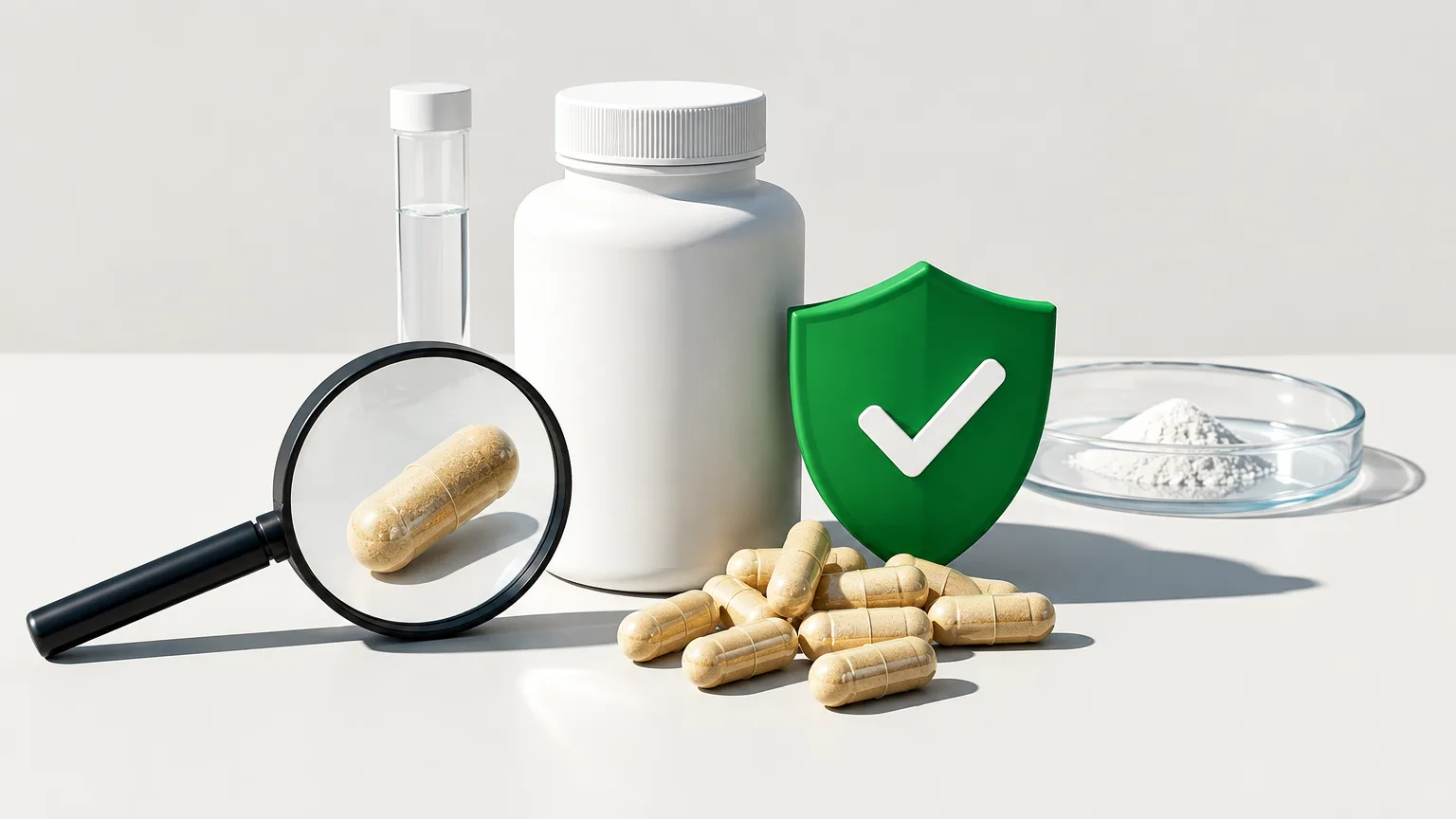
What independent testing can tell you
“Third-party tested” means someone outside the supplement company evaluated some aspect of the product. The phrase alone tells you little about the scope of that evaluation. A laboratory might test a sample for lead; a certification program might also check ingredient amounts, review labels, inspect the manufacturing facility, and retest products sold in stores.
Depending on the program and the ingredient, useful checks include:
- Identity: Is the stated ingredient present? For a botanical, testing may help distinguish the intended plant from a substituted or misidentified one.
- Potency: Does the product contain the stated amount of a tested ingredient? A capsule labeled “200 mg” should not require you to guess what it delivers.
- Contaminants: Does the product meet the program’s limits for substances it screens, such as certain heavy metals, microbes, pesticides, or undeclared ingredients?
- Manufacturing and performance: Has the facility met the program’s requirements? For a tablet, has the product met a standard for breaking down and releasing its ingredients?
The exact tests matter. “Tested for contaminants” does not mean tested for every possible contaminant, and “passes” generally means a product meets specified limits—not that it contains no detectable trace of a substance. The NIH Office of Dietary Supplements notes that independent quality seals can indicate proper manufacturing, accurate listed ingredients, and acceptable contaminant levels, but they do not guarantee that a supplement is safe or effective.
Know what the major seals mean
Look for the name of a program and its mark on the specific product, not a broad claim that the brand is “certified.” Programs differ, and some organizations offer several types of certification.
USP Verified
The USP Verified Mark applies to finished supplement products that meet the U.S. Pharmacopeia’s verification requirements. The USP program checks labeled ingredients and amounts, specified contaminants, manufacturing practices, and whether applicable products break down and release their ingredients. It also includes product testing after verification.
That makes USP Verified a strong quality signal for a product carrying the mark. It does not mean USP has shown that the supplement treats a condition or that its dose is right for you. Be precise when reading the package: “USP Verified” is a product verification claim; a statement that an ingredient meets a USP standard is not, by itself, the same claim about the finished bottle.
NSF Contents Certified and NSF Certified for Sport
NSF’s Contents Certified program checks ingredient identity and label accuracy, screens for contaminants based on product risks, and conducts ongoing facility audits. For a shopper whose main concern is whether an everyday supplement matches its label, this is the relevant type of assurance.
NSF Certified for Sport adds screening aimed at substances prohibited in sport. If you compete under drug-testing rules, look for the Certified for Sport mark specifically; another NSF certification is not interchangeable. The U.S. Anti-Doping Agency recommends this program to athletes who choose to use supplements, while stressing that certification reduces rather than eliminates the risk of a positive test.
ConsumerLab.com Approved Quality
ConsumerLab.com tests products it selects for reviews and also has a program through which manufacturers can request testing for potential certification. Its evaluations address criteria such as ingredient amounts, specified contaminants, and, where relevant, whether a product breaks apart properly. A product that passes may qualify for its Approved Quality seal; ConsumerLab.com explains its testing, certification, and seal-use policies on its site.
These are quality programs, not competing verdicts on whether you should take a supplement. Choose the kind of check that fits your concern, then confirm that the particular product—not merely its manufacturer—has earned it.
Verify the product before you pay
A logo on a product image is a starting point, not the final check. Packaging can change, and a brand may sell certified and uncertified versions of similar products. Use this short sequence when comparing bottles online or in a store:
- Match the full product name. Check the brand, ingredient, strength, form, and, where listed, the package or product identifier against the certifier’s record. USP has a searchable list of USP Verified products, while NSF provides a directory for its certified dietary supplements. Don’t assume that a brand’s other strengths or formulations are included.
- Check the kind of certification. An audit of a manufacturing facility is useful, but it is not the same as independent testing and certification of the finished product. For an athlete, confirm the listing in the NSF Certified for Sport product directory, which can be searched by product name or lot number.
- Read the Supplement Facts panel. Confirm the serving size, the amount per serving, and how many capsules or scoops make up that serving. Then check “Other Ingredients” if you need to avoid a particular additive. The seal helps you trust tested label claims; it does not choose an appropriate dose for you.
- Ask what an unsupported testing claim covers. If a company says only “third-party tested,” look for the laboratory’s name, which finished product and lot were tested, when testing occurred, and which ingredients or contaminants were measured. If it offers a certificate of analysis, check that its product and lot identifiers match your bottle and that it shows actual results and limits—not just the word “pass.”
A test report for an incoming raw ingredient may be worthwhile, but it does not establish the quality of every finished bottle. Likewise, a single tested sample tells you less about ongoing consistency than a program with repeated product checks. An uncertified product isn’t automatically poor quality; its quality is simply harder for a shopper to verify from a label claim alone.
Don’t let a seal make the health decision for you
Testing can confirm that a supplement contains its stated dose. It cannot establish that the dose will benefit you. A tablet that reliably releases an ingredient still needs evidence that the ingredient helps with the outcome you care about. NIH notes that evidence for the health benefits and risks of dietary supplements varies widely by ingredient.
Nor does accurate labeling make an ingredient harmless. Supplements can interact with medicines, duplicate nutrients in other products, or supply more than you intended to take. Consider a verified bottle of vitamin D: verification may give you greater confidence in its contents, but too much vitamin D can be harmful. The right amount depends on your circumstances and what you get from other sources—not on the presence of a seal.
Watch for a different label problem in multi-ingredient products. Under FDA labeling rules, a proprietary blend may disclose its total weight without giving the amount of each ingredient in the blend. That can make it difficult to judge whether a particular ingredient is present at a useful or appropriate dose. If the amount matters to your decision, favor a product that states it plainly.
The best order of operations is simple: decide with a clinician or pharmacist whether the supplement and dose make sense for you, then seek independent verification of the product you plan to buy. For most shoppers, a verifiable finished-product quality seal is a practical advantage. For drug-tested athletes, sport-specific certification deserves special attention. Neither replaces a sound reason to take the supplement in the first place.
Disclaimer
This article provides general health information, not individualized medical advice. Ask a qualified health professional about supplements if you take medication, have a medical condition, or are pregnant or breastfeeding.