A coin collection can begin with a quarter from your change. The harder part is deciding why that quarter belongs in the collection—and whether the next one you buy is worth its asking price.
Start with three decisions: what you’ll collect, what condition you’ll accept, and where each coin will go. Make those decisions before shopping for scarce dates or expensive sets. You’ll spend less on duplicates, learn to spot damage, and give the coins you already own a better chance of staying as they are.
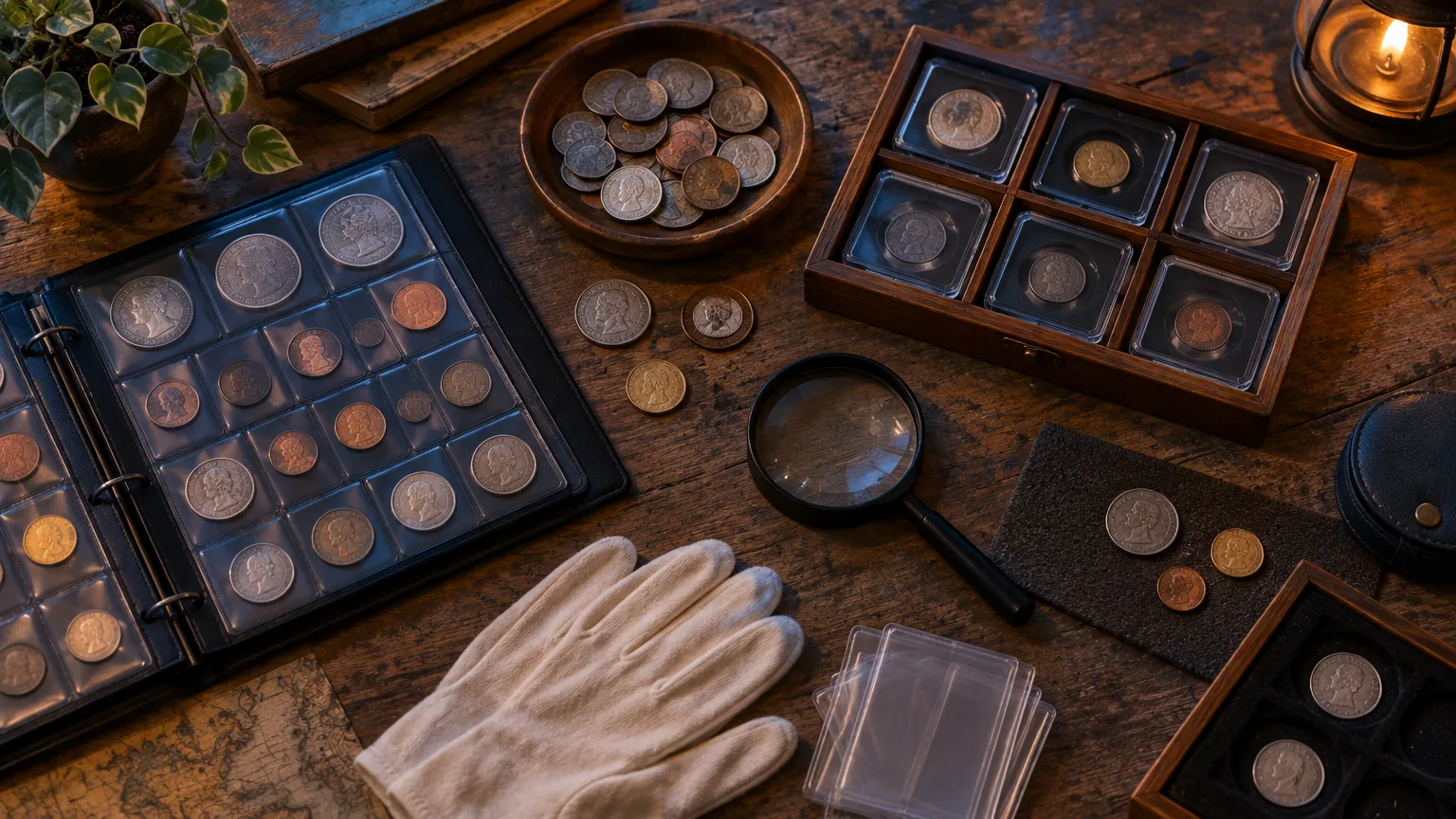
Choose a focus you can explain in one sentence
“Interesting coins” is a fine reason to look through a jar, but it isn’t much help when you’re facing hundreds of choices at a coin show. A useful focus sets boundaries. The U.S. Mint lists denomination, date, mint mark, country, finish, and design theme among the ways collectors organize their coins.
You could collect one example of each quarter design you find in circulation, Lincoln cents from a chosen decade, or coins depicting animals. Then decide what counts as complete. For the quarter collection, is one of each design enough, or do you want an example from each mint? Do worn coins count? Those choices determine both the size of the project and what you’ll need to spend.
For a first collection, pick a focus that lets you examine several coins without buying them. If you like older U.S. coins, a small type collection—one example of several different designs—may be more satisfying than trying to fill every date and mint-mark slot in a long series. If a particular series catches your eye, read a guide to it before setting a completion goal. Some slots may be far harder to fill than the others.
Write your rule down, but allow yourself to change it. A collection should become more deliberate as you learn, not trap you into buying coins you no longer want.
Sort what you have before you buy
Spread out a small group of coins on a clean, soft surface. Record the denomination or type, date, mint mark if present, and any design or condition notes. A mint mark identifies a production facility, but its absence isn’t automatically an error: many U.S. circulating coins made in Philadelphia carry no mint mark. Check a reference for the particular coin before treating an unusual-looking detail as rare.
Keep a simple inventory in a notebook or spreadsheet. One line per coin is enough: identification, approximate condition, where you found or bought it, what you paid, and where it’s stored. Add a photo when two similar coins might be hard to tell apart later. This modest bit of recordkeeping shows gaps in your collection and stops you from paying twice for a coin you already own.
A beginner’s useful supplies are equally modest: good lighting, a magnifier, a reference for the coins you collect, and suitable holders. You don’t need a cabinet full of accessories before you’ve settled on a focus.
Learn to grade by looking for wear first
A grade describes a coin’s condition, not its age or how much you like its design. The standard numeric scale runs from 1 to 70, with letters that describe a broad condition range. Learn the ranges rather than trying to guess an exact number for every coin you find. On NGC’s grading scale, common circulated ranges include Good (G-4 to G-6), Fine (F-12 to F-15), Very Fine (VF-20 to VF-35), Extremely Fine (XF-40 to XF-45), and About Uncirculated (AU-50 to AU-58). Mint State begins at MS-60. Not every number below 60 is used.
For a circulated coin, ask how much of the design has worn away. Compare the high points—the parts most exposed to handling—with clear images of the same coin type. Don’t mistake a weakly struck detail for wear; a coin may have left the mint with that detail incomplete.
Then look at the surfaces. A coin can have little or no circulation wear yet still show marks or scratches from handling. Among Mint State coins, strike, luster, surface preservation, and overall appearance help explain why one uncirculated coin receives a different grade from another. “Uncirculated” does not mean flawless.
Proof is different: it describes a coin made using a special production process for collectors, not a grade meaning “perfect.” Grading labels commonly use PF or PR for proofs; a proof coin can still have marks or other impairments. NGC uses PF, while the Mint State prefix MS applies to uncirculated coins struck in the format of circulation issues.
Practice with a range, not a verdict
Pick three coins of the same type with visibly different amounts of wear. Under steady light, compare both sides and note which design features disappear first. Then use PCGS Photograde’s coin photographs to estimate a range for each coin. It’s a comparison exercise, not a substitute for an expert opinion.
Be particularly cautious at the AU-to-MS boundary, where a slight trace of wear matters. For an inexpensive coin, “roughly VF” is often enough to make a collecting decision. Save precise grade debates for coins where the difference would materially change what you pay.
Watch for problems that a wear grade alone cannot convey. Cleaning, a hole, corrosion, or significant scratches may lead a grading service to assign a “Details” designation rather than a standard numeric grade. A coin labeled “XF Details,” for example, has substantial design detail remaining; the label does not mean it should be priced like a problem-free XF coin. NGC explains its Details grades in terms of both remaining detail and the surface problem.
Store each coin so it won’t acquire new damage
The easiest preservation rule is to keep coins from rubbing against one another. Put collectible coins in individual holders rather than letting them knock around loose in a drawer or bag. Hold an unprotected coin by its edges over a soft surface, and put it away after examining it.
For most early collections, an album designed for the series or individual holders will do the job. Look for acid-free cardboard and plastic explicitly identified as PVC-free; don’t assume any clear plastic sleeve is safe for long-term use. The U.S. Mint describes albums, 2-by-2-inch holders, capsules, and protective cases as storage options, and warns that PVC and acidic materials can harm a coin’s surface. Keep collector sets in their original protective packaging when practical, along with any accompanying documentation.
Match the holder to the coin. An album makes a modest date or design set easy to see. An individual holder gives you room to label an unusual piece without writing on anything that touches it. A fitted hard-plastic holder offers protection for a coin you expect to handle or inspect often. A professionally graded coin normally stays in its sealed holder.
Store the collection somewhere cool and dry with a fairly stable temperature. The American Numismatic Association recommends individual containers and a dry environment for long-term storage. Check the collection now and then for moisture or changes to the coins and holders; storage isn’t a task you do once and forget.
Resist the urge to improve a coin’s appearance. Rubbing or polishing can leave scratches and remove original surface character. If a coin has sticky residue or another apparent problem, set it aside and seek experienced advice rather than experimenting with household cleaners. You can replace a holder; you can’t undo an abrasive cleaning.
Buy the next coin with a specific gap in mind
Once your first coins are identified and safely stored, make a short want list. For each gap, note the coin you’re seeking, the condition you’d be happy to own, and the most you’re comfortable paying. That turns a shop visit from a hunt for anything appealing into a chance to compare real options.
For U.S. coins, a price guide can provide a starting point, but read what its figures represent: PCGS describes its guide as average dealer asking prices for PCGS-graded coins, not guaranteed selling prices for every coin. Compare coins of the same date, mint, and condition, and account for visible problems.
When buying online, inspect photos of both sides and read the return terms before paying. If the photographs hide part of the surface or the seller cannot answer a basic identification question, pass. The American Numismatic Association advises checking seller reputation, coin photographs, and return policies; it also recommends reputable third-party certification for expensive key coins. A grading service’s sealed holder can help with authentication and condition, but it doesn’t remove the need to examine the coin and the seller.
Buy slowly enough to learn from each addition. If you can say why a coin fits your focus, describe its condition in plain terms, and place it in a suitable holder when it arrives, you’re building a collection rather than accumulating loose change.