A can of soup can look like a modest choice until you notice that its Nutrition Facts label covers half the can. The sodium number didn’t change when you ate the rest; the amount you consumed did. That’s why the most useful place to start reading a label isn’t the calorie line or a claim on the front. It’s the serving size.
You don’t need to study every number on every package. For most comparisons, a quick pass works: check how much food the numbers describe, look at the nutrients that matter to your choice, then use the ingredient list to make sense of what’s inside. The front of the package can wait.
Start with the serving size
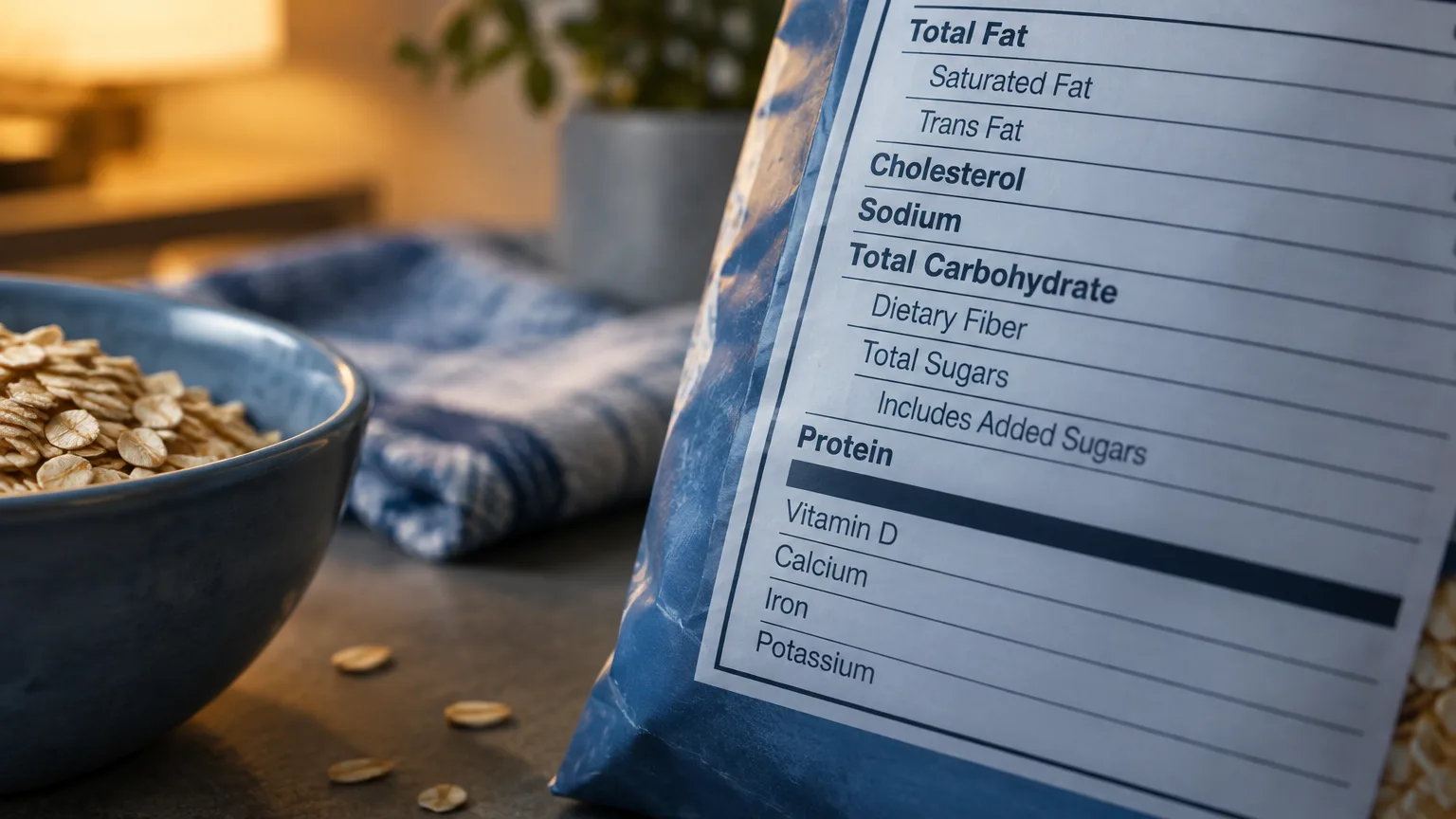
At the top of the panel, find “servings per container” and “serving size.” Most of the calories and nutrients below describe one serving, not the entire package. The serving size reflects an amount people typically eat or drink; it isn’t advice about how much you should have.
If a label lists 280 calories and 850 milligrams (mg) of sodium per cup, two cups provide 560 calories and 1,700 mg of sodium. The same multiplication applies to added sugars, fiber, and the other nutrients. Some packages show two columns—one per serving and one per container—so you can skip the math if you eat the whole thing.
Serving size matters just as much when comparing brands. One soup may list sodium per cup while another lists it per half-cup. Comparing the printed numbers alone would favor the smaller serving even if that soup has more sodium in the amount you’d actually eat. Match the amounts first, using cups, pieces, or the weight in grams shown beside the serving size.
Use percent Daily Value to put a number in context
The percent Daily Value (%DV) tells you how much one serving contributes toward the reference amount for a particular nutrient. It is calculated separately for each nutrient; the percentages down the label aren’t supposed to add up to 100.
The FDA’s quick guide to %DV calls 5% DV or less low and 20% DV or more high. That makes the column useful even when grams and milligrams are hard to judge on sight. For nutrients many people aim to limit, such as sodium, added sugars, and saturated fat, a lower %DV generally helps. For nutrients such as fiber, calcium, and potassium, a higher %DV may be useful.
Treat those cutoffs as comparison tools, not grades for whole foods. A food with 20% DV of sodium isn’t automatically a poor choice, and one with 5% DV of added sugars isn’t automatically nutritious. Look at what the food contributes, what you’ll eat with it, and how much of it you’ll have. Daily Values are general reference amounts; a clinician may set different targets for someone with a medical condition.
Read “added sugars,” not just “total sugars”
“Total Sugars” includes both sugars naturally present in the food and sugars added to it. A plain yogurt can have total sugars from milk while listing zero added sugars. A sweetened yogurt can have both. The “Includes” line beneath Total Sugars tells you how many of those grams are added; don’t add the two lines together.
The Daily Value for added sugars is 50 grams on the label’s 2,000-calorie reference diet. A product with 10 grams of added sugars per serving therefore provides 20% DV. Total sugars have no %DV, so the added-sugars line is usually the better place to start when comparing, say, two flavored yogurts or breakfast cereals.
Added sugars aren’t limited to an ingredient named “sugar.” They can come from honey, syrups, and certain concentrated fruit or vegetable juices. Their presence doesn’t mean you must reject a food; the question is how much the food adds to your day and what else it offers. If you’re choosing between similar cereals, for example, compare added sugars alongside fiber rather than picking the one with the lowest sugar number in isolation.
Single-ingredient sweeteners such as honey and maple syrup are a labeling wrinkle: their added-sugars information may appear differently from that of a food made with several ingredients. Don’t mistake “nothing was added to the honey” for “the honey doesn’t count toward added-sugars intake.”
Give sodium its own check
Sodium is easy to overlook in foods that don’t taste especially salty. Bread, soup, sauces, and prepared meals can all contribute, so the number on the panel is more reliable than taste. The Daily Value for sodium is less than 2,300 mg a day. A serving with 460 mg supplies 20% DV; two servings supply 40%.
Watch both the amount in milligrams and the %DV. Milligrams help when you’re working with a specific daily limit; %DV makes a fast comparison between products with matching serving sizes. If you eat more than one serving, recalculate. A condiment with a small printed serving can add up when used freely.
Front-label sodium claims have distinct meanings. “Low sodium” means 140 mg or less per serving, while “reduced sodium” means at least 25% less than the regular product. “Reduced” is a comparison, not a promise that the final number is low. “No salt added” means salt wasn’t added during processing; it doesn’t guarantee a sodium-free food. Turn the package over and check the number you’ll actually consume.
Let the ingredient list answer a different question
Nutrition Facts tells you how much of certain nutrients a serving contains. The ingredient list tells you what went into it. Ingredients appear in descending order by weight, so the first few are a useful clue to the food’s main components. The list does not, however, tell you the exact amount of each ingredient.
For a grain product, look for a clearly named whole grain—such as whole wheat flour or oats—among the leading ingredients. A package can feature grains on the front without telling you how much of them are whole. Check fiber on the Nutrition Facts panel as well; neither the ingredient list nor one nutrient number gives you the full picture.
For a sweetened food, scanning for sugar, syrups, honey, or other sweeteners helps explain the added-sugars figure. But don’t try to estimate total added sugar by counting sweetener names. The panel gives you the more useful quantity. Nor is a long ingredient list, by itself, a measure of nutritional quality: use it to answer a specific question about the food rather than as an automatic pass-or-fail test.
Put front-of-package claims in their place
Claims can help you find a product worth checking, but they don’t replace the panel. “No added sugar” does not mean sugar-free: a food can still contain naturally occurring sugars. It also tells you nothing by itself about calories, fiber, or sodium. “Reduced sodium” tells you how a product compares with its regular version, not how it compares with every other brand.
The word “natural” is especially limited as a nutrition guide. The FDA’s policy on “natural” does not treat it as a statement of nutritional or health benefit. By contrast, foods using the regulated “healthy” claim must meet specified food-group and nutrient criteria. Even then, the claim is a starting point, not a substitute for checking the serving size and the nutrients important to you.
Compare the amount you would actually eat
Suppose two soups are side by side. Soup A lists 480 mg of sodium per 1-cup serving. Soup B lists 300 mg per half-cup serving. At first glance, B looks lower. For the same 1-cup amount, though, B provides 600 mg—more than A. These are illustrative numbers, but the calculation is the one that matters at the store.
A practical comparison takes four steps:
- Choose the amount you expect to eat and bring both labels to that amount.
- Compare the nutrients relevant to that food—perhaps sodium for soup, added sugars for yogurt, or fiber for cereal.
- Check for trade-offs. A lower-sodium choice may differ in fiber, saturated fat, or portion size.
- Read the leading ingredients and any front-label claim that influenced your choice.
You rarely need a perfect product. You need an honest comparison. Once the serving sizes match, the label becomes far easier to use—and far less likely to reward the package with the cleverest wording.
Disclaimer
This article provides general nutrition information, not individualized medical advice. If you’ve been given a specific nutrient target, use that guidance when reading labels.